179 reading right now Launch Promo ends in --:--:--
Get Full Bundle $47
The Arms Archives · Second Edition

A Rifle For My Son
— And What He'll Never Know About It.

The vanishing world of the American hunter — and the four-second skill that reads what's left of it. Second edition, with the companion volume. Choose your edition below.

0Pages
0Volumes
0Money-Back Guarantee
SAVE
$20
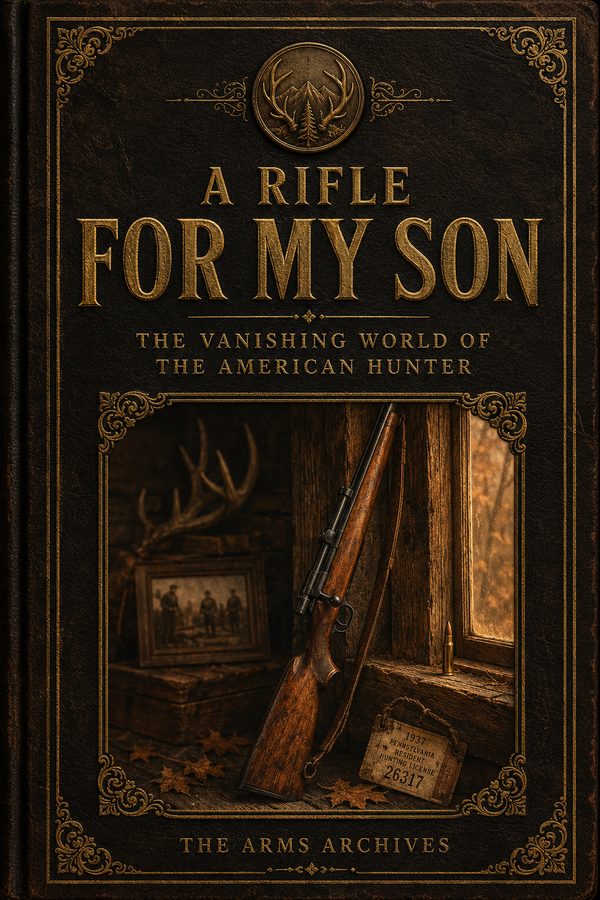
A Rifle for My Son, book cover SECOND EDITION

A Rifle for My Son

240 pages. Second Edition. Ends in ruled pages you fill in. Print, Kindle, instant download.

$47 $27
You save $20 today
  • The air rifle at six, the catechism, the first sparrow — where a boy started
  • The cuts, dated one at a time: 1964, North Haven, Southgate, Ilion, 2006
  • The thinning — the shack, the blood on the face, why the boy didn't come
  • A field guide to the vanished rites, set down before the last men who knew them
  • Ruled pages at the back: you're the last person alive who holds it
Start the Record →
7-day money-back guarantee
🔒 Secure · Visa · Mastercard · Apple Pay
SAVE
$20
Know What You're Handing Him, book cover FIRST EDITION

Know What You're Handing Him

287 pages. Four parts. Every claim tier-marked. Instant download.

$57 $37
You save $20 today
  • Identify any American gun in two minutes — six physical acts, no tools, no internet
  • The full mark key — Winchester, Remington, Marlin, Savage, Mossberg, with dates
  • The house-brand decoder — what your Sears, Higgins or Western Field number actually means
  • Every claim tier-marked — factory record, strong consensus, or disputed
  • Spot a reblue, a sanded stock, a parts gun or a fake, in the order that matters
  • Read a rifle's wear — scabbard-carried, slung, shot hard, or safe-queened
Learn to Read Them →
7-day money-back guarantee
🔒 Secure · Visa · Mastercard · Apple Pay

Every rifle worth owning is bought twice.

Once by the man who carries it — and once, in his mind, by the boy he means to give it to. He knows the year it was made, the man who carried it before him, what it cost new. What he doesn't know is whether anyone will take it. A Rifle For My Son is the covenant. Know What You're Handing Him is how the next man keeps it.

⚠ This Price Expires In

--HOURS
--MINUTES
--SECONDS
Drawn from federal hunting-participation data, published firearms histories & firsthand accounts from New Haven and the deer camps

What's Inside

Six parts. Thirty-four chapters. Seven appendices. One vanishing world.

01

The First Gun

Part One

Plymouth 1886, Rogers Arkansas, the Red Ryder in 1938. The air rifle at five or six, almost always at Christmas. The safety catechism recited word-perfect to a father who answered only not quite until the boy had it exactly. The backyard, the green army men, the sparrow that did not get up — and the six words a father said about it.

02

The Second Gun

Part Two

The .22 across the counter and a week's wages handed over with it. The rifle that taught patience, the Marlin 39A, eleven million Model 60s. The kitchen table on a Tuesday with the gun in pieces and Hoppe's No. 9 in the air. And the names that belong to no company that ever existed — J.C. Higgins, Ted Williams, Western Field, Revelation, Glenfield.

03

The Making

Part Three

The men who taught America what to want, and the magazine that arrived on the kitchen table every month. Steel. The Mauser claw. Walnut. The cities that made them. And twenty thousand men in New Haven fitting wood to metal by hand.

04

The Cuts

Part Four

One dated decision at a time. 1964 at Winchester, and what the company said about it that year. New Haven to North Haven. Wingmaster and Express. Southgate, California, 1991 — told by a gunsmith who was on that floor and lost his job fighting for the standard. JM. Ilion, after two hundred and eight years. And March 31 to April 1, 2006.

05

The Thinning

Part Five

The last man with nothing to sell. The empty stands. The shack that ran for a century, holding the dead in the company of the living. The blood on the face. Why the boy didn't come. And the last man at camp — a Sunday night thousands of men have lived, each believing himself alone in it.

06

The Handoff

Part Six

The rifle comes off the wall, and the question the whole book has been asking gets asked out loud: will there be anyone to take it? The book does not pretend to answer it. It ends with two pairs of hands at the edge of a field in November.

07

The Reference Vault

Appendices I, II, III, V

How to read a gun in four seconds — bottom metal, checkering, extractor, bluing, wood-to-metal fit. Serial numbers and date codes, including the pre-64 Model 70 cutoff and the Marlin and Remington barrel codes. The house-brand decoder. And the numbers: the 1982 peak at 16.7 million hunters, and the age wall that four percent of men over sixty-five are still on the right side of.

08

What Was Never Written Down

Appendices IV, VI, VII

A field guide to the vanished rites, set down because a rite carried only in the doing disappears the first season it isn't done: the catechism, the withdrawal, the blooding, the buck pole, the letzter Bissen, holding court, the horns, and the radio reading births and deaths into the dark at camp. Then the practical business of passing it on — wills, family exemptions, state lines, honest appraisals. And ruled pages for the record only you can write.

Companion Volume

Know What You're Handing Him

The first book tells you what was taken out. This one teaches you to see it — six physical acts, in order, before you read a single letter on the barrel.

00

What the Counter Man Could See

Part Zero

How the knowledge actually moved: the counter, the catalogue, the kitchen table on a Sunday, the loan, and the swap meet where you found out whether you could really do it. And where all of it went.

01

The Six Acts

Part One

The lift. The thumb. The light. The seam. Underneath. The bolt. Then the marks — last, not first, and the chapter explaining why that order matters more than anything else in the book. Not one of the six requires a tool.

02

The Makers

Part Two

Winchester, Remington, Marlin, Savage, Mossberg, Daisy, Cooey and the second tier. Where the marks are, what each one means, how to date it — and where the record is broken and honestly cannot answer you.

03

The House-Brand Decoder

Part Three

Sorted by the number stamped on your gun, not by the brand name. Because a man holding a receiver that reads 583.2085 doesn't know it's a J.C. Higgins. He knows the number.

04

The Owner's Practice

Part Four

The cardboard box test. The seven photographs that survive a fire, a theft report or an estate. Storage. When to leave a worn rifle alone. And four letter templates for writing the factory.

Plus the Disputes Register, a glossary, and a source list organised by what each source can and cannot answer.

Reader Notes

From the field.

— Illustrative reader reactions based on the book's themes —

★★★★★

"I read the chapter on the blooding out loud to my son the night before his first hunt. Neither of us made it through dry-eyed."

— R. Halloway, Michigan
★★★★★

"I've told the story of my grandfather's Model 70 a hundred times, but I never understood why 1964 mattered until this book explained it. Now I know exactly what I'm holding."

— J. Ostrander, Vermont
★★★★★

"The chapter on the New Haven factory closing hit harder than I expected. My uncle worked that line for thirty years."

— C. Marsh, Idaho
★★★★★

"Appendix IV alone was worth the price. I finally sat down and wrote out the history of my father's rifle before I forget the details myself."

— D. Reinholt, Wisconsin
★★★★★

"Our camp went from fifteen men to four over twenty years. Reading 'The Last Man at Camp' felt like reading my own Sunday nights."

— T. Callahan, Pennsylvania
★★★★★

"This isn't really a gun book. It's a book about fathers and sons that happens to be about rifles. I bought copies for both of mine."

— B. Hutchins, Wyoming
Common Questions

Before you order.

Two books, complete. A Rifle For My Son, second edition — 240 pages, six parts, thirty-four chapters and seven appendices. And Know What You're Handing Him — 287 pages, five parts, including the house-brand decoder and the Disputes Register. Both delivered as instant downloads.
No, and plenty of men won't. A Rifle For My Son is the story — the world these rifles came out of, and the handoff that may or may not happen. Know What You're Handing Him is the method — how to pick up a gun you've never seen and read it. Buy the first if you want the history. Buy both if you want to be able to do something with it.
Second edition, and it's nearly three times the first. Eight new chapters on the years before the .22 — the air rifle, the catechism, the sparrow. The cuts proved with dates rather than asserted, including a gunsmith who was on the floor at Southgate in 1991. A full reference vault. And ruled pages at the back. Readers' own accounts are in it, identified by place and age rather than by name.
No. Every update is free for life. The second edition has already gone out to first-edition readers, and anything that comes after it will too. Buy once, and you get the book as it stands and as it grows.
You get it, free, for as long as the book exists. Corrections come in from men who were there — a date, a serial range, a rite practiced in one county and nowhere else — and the book absorbs them. That's how the second edition happened.
A Rifle For My Son is a history with a reference vault at the back. Know What You're Handing Him is a working manual. Both are written so the man who has handled guns for fifty years doesn't catch you out on page nine.
Every entry in the reference sections is graded. [SOLID] — established and consistent across the standard references. [GENERAL] — right in the great majority of cases, but transition guns and gunsmith swaps exist. [VERIFY] — the shape is right, check the specifics against a dedicated reference before money changes hands. Where the record is thin or disputed, the book says so rather than handing you a confident wrong number.
Then you're the intended reader. This isn't for the man who can't tell a Marlin from a Mossberg. It's for the man who has known for fifty years that one rifle feels right and another doesn't and has never had the words for why — and who now needs to say it out loud to somebody who wasn't there.
Some of it. And five sites will agree with each other while all five are wrong, because they're copying the same estimate. The books show you where that happens, and what the surviving record actually supports.
No. Winchester is one part of six. The books cover Remington, Marlin, Savage, Mossberg, Daisy, Cooey and the house brands — J.C. Higgins, Ted Williams, Western Field, Revelation, Glenfield — along with the camps, the rites, the making, and the federal numbers behind the decline.
A register for your own rifles: maker, model, serial, year, what it cost, who carried it, the hunts, the story behind every mark, and who it goes to next. That information exists in exactly one place — in you. Fill them in and the book goes in the case with the rifle, and the next man opens it and knows what he's holding.
The cardboard box test. Two air rifles seventy years apart, one empty box, about thirty dollars. It's the only claim in the book a boy can establish with his own hands in an afternoon, and it's why that chapter exists.
Instant download, straight after checkout. No shipping, no waiting, and you can read it tonight.
Seven days, money back, no questions asked. Keep the files either way — if the book didn't do what it promised, we'd rather you told us than paid for it.
$104$47 today Get Full Bundle
S
Susan from Cambridge, MA
just got A Rifle for My Son
2 minutes ago